

Sea Temperature in Split by Month: When the Adriatic Is Warm Enough to Swim
29 August 2026
In May, the sea off Split is warmer than the air above it. In September it is still sitting at its August temperature, weeks after the crowds have gone home. Both come down to the same stubborn fact: water is slow, warming all summer and giving that heat back through autumn. Here is the month by month breakdown for Split, with the sources and measurement periods the other tables leave out, plus what bura and jugo do to the water once you are in it.
Key Takeaways
- The sea off Split is warmest in August and coldest in February or March.
- It lags the air by roughly a month, which is why September swims better than June.
- The comfortable stretch runs from about June to early October.
- Bura cools the surface and roughens it; jugo brings warm but restless water.
- Sea and air figures both cover 1991-2020, so the two are directly comparable.
How Warm Is the Sea in Split, Month by Month?
The sea off Split averages 11°C in the depth of winter and peaks around 25 to 27°C in August. Monthly sea figures below draw on Copernicus Climate Change Service climate averages for 1991-2020. Air figures are the WMO climate normals for the same 1991-2020 period, measured at the Split-Marjan station and published by NOAA's National Centers for Environmental Information.
| Month | Sea °C | Sea °F | Air °C | Swimmable? |
|---|---|---|---|---|
| January | 11 | 52 | 8.2 | No |
| February | 11 | 52 | 8.7 | No, coldest |
| March | 14 | 57 | 11.3 | No |
| April | 16 | 61 | 14.9 | Brave only |
| May | 21 | 70 | 19.7 | Yes, warming |
| June | 24 | 75 | 24.2 | Yes |
| July | 27 | 81 | 26.8 | Yes, peak |
| August | 25-27 | 77-81 | 26.8 | Yes, warmest |
| September | 24 | 75 | 21.7 | Yes, best value |
| October | 20 | 68 | 17.4 | Yes, tailing off |
| November | 16 | 61 | 13.1 | Brave only |
| December | 12 | 54 | 9.4 | No |
One thing to read carefully in that table: the air column is the average across the whole 24 hours, nights included. That is why August shows 26.8°C rather than anything that sounds like a beach day. The figure you actually stand in is the average daily maximum, which in Split runs 28.1°C in June, 31.0°C in July and 30.9°C in August. Same data, different question.
August appears as a range on purpose. High-summer surface temperature moves with the year, with how sheltered the spot is, and with how much wind has come through in the previous week. A single figure would be tidier and less true, so the band is what you can actually expect to swim in.
Why Does September Swim Better Than June?
Because water takes far longer to heat and cool than air does, so the sea runs about a month behind. June air averages 24.2°C and the sea 24°C. September air drops to 21.7°C, but the sea is still 24°C. Same water, cooler air, emptier beach.
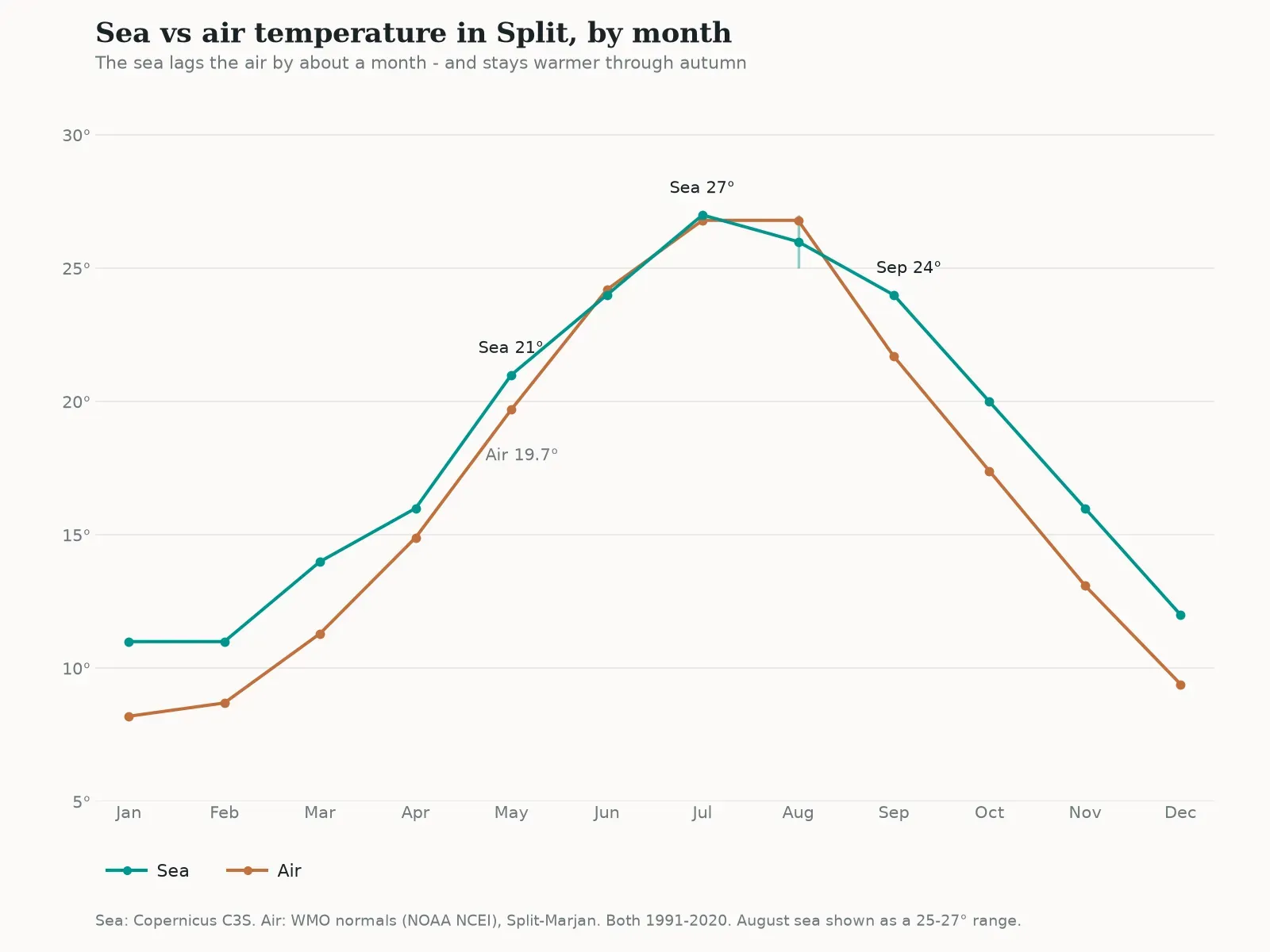
May makes the lag even clearer. Air sits at 19.7°C while the sea has already reached 21°C. The water's warmer than the air you walk into it from, which isn't what most people expect in spring.
The physics is unglamorous. Water has a much higher heat capacity than air, so a mass of sea absorbs a great deal of summer sun before its temperature moves much, then releases it slowly through autumn. August sunshine is effectively paid back in September and October.
That single fact reshapes the calendar. If you're choosing between early summer and early autumn, autumn wins on water temperature, crowd levels and price, and loses only on daylight hours.
When Does the Swimming Season Start and End?
Practically speaking, June through early October, with May and mid-October as the edges. Most people find water comfortable for a long swim from about 20°C upward; below 18°C, swims get short.
Split crosses that 20°C line in May and stays above it into October, which is a five to six month window on paper. In practice the shoulder months feel different from the middle ones.
May reads 21°C in the water but only 19.7°C in the air, so the sea's fine and getting out is the problem. Bring something to put on straight away.
October holds up better than people expect at 20°C. The water is still summer-warm while the air has dropped to 17.4°C, so it is the mirror image of May.
November falls to 16°C. That's wetsuit territory rather than swimsuit territory, and by December at 12°C it's a plunge, not a swim.
When Is the Adriatic Warmest and Coldest?
Warmest in August and coldest in February or March, and that holds along the whole coast. Research from the Geophysical Department of the University of Zagreb, drawing on Penzar and colleagues (2001), found that every measuring station on the Adriatic records its maximum sea temperature in August, and its minimum in either February or March.
The coldest point arriving after winter rather than during it is the same lag working in reverse. The sea keeps giving up heat through January and only bottoms out once the air has already started to turn.
For scale, across the entire Adriatic between 1911 and 1964, the recorded surface extremes were 4.1°C at the low end and 28.8°C at the high end. Those are outliers at the far edges of the basin, not Split numbers, but they mark the boundaries of what the sea here does.
Is the Sea Warmer in the North or the South?
In winter the northern Adriatic runs about 3°C colder than the south. In summer that gap almost disappears.
The reason for the summer evening-out is river water. The northern Adriatic takes a heavy freshwater inflow, above all from the Po, which flattens what would otherwise be a clean north-south gradient.
Split sits well for this. The same research notes that values rise as you move toward the open sea, and names Split and Hvar as examples. Being on a coast that faces open water rather than a shallow enclosed gulf means the sea here behaves more like the middle of the basin than the head of it.
What Do Bura, Jugo and Maestral Do to the Sea?
Wind changes both the surface temperature and how rough the water is, sometimes overnight. Three matter on this coast, and locals name them before they name the forecast.
Bura
Cold, dry and gusty, coming down off the mountains from the northeast. It mixes the surface layer and drags colder water up, so after a strong bura the sea can feel noticeably cooler than it did the day before. It also kicks up short, sharp, choppy waves. Clear skies and excellent visibility usually follow, which is why a bura day looks beautiful in photographs and swims badly.
Jugo
Warm and humid, blowing from the southeast. It doesn't cool the water, but it pushes long waves and turns the sea murky and restless. Jugo tends to settle in and last for days rather than hours, often with cloud and rain behind it.
Maestral
The summer afternoon breeze off the sea, moderate and predictable, building through the day and dropping in the evening. It's the sign of settled weather, and it's the one of the three that improves a beach afternoon rather than ending it.
Where Can You Check Today's Sea Temperature?
Everything above is a climate average, not today's reading. For the actual current temperature, the Croatian Meteorological and Hydrological Service publishes measured sea temperatures from its coastal stations, updated daily.
The distinction matters. An average tells you what to expect when you book something months ahead. A measurement tells you what you are walking into this afternoon. They answer different questions, and a monthly average won't ever be the right tool for the second one.
Which Month Should You Visit Split for Swimming?
Work backwards from what you want out of the water.
- Warmest sea goes to August, at its 25-27°C peak.
- Best overall value is September: the same 24°C water, air down to 21.7°C, and a fraction of the crowds.
- Warm sea, lower prices points to June, at 24°C.
- Only if cooler water is fine covers May and October, both around 20-21°C.
- Brave only are April and November, matching at 16°C either side of the season.
- Not for swimming runs December through March.
For most people asking the question, September is the answer, and it isn't close. The sea is at its August temperature, the air has stopped being oppressive, and the beaches have emptied.
If you're working out where to spend that afternoon, Žnjan beach sits on the eastern side of the city with the open sea in front of it, and our guide to things to do in Split covers the rest of the day. For the early part of it, breakfast by the sea runs through the options by zone.
The Short Version
The sea runs about a month behind the air, and that single lag explains most of what people find surprising about swimming here. It explains why May water beats May air, why September holds August temperatures, and why the coldest water arrives in late winter rather than the middle of it.
August if you want the warmest sea. September if you want the best swim.
- Split
- Sea
- Weather
- Croatia
Continue reading
More from the Journal
 Travel8 September 2026
Croatian Phrases You'll Actually Use as a Tourist
The Croatian you need to walk in, order, ask and pay, arranged in the order it happens rather than alphabetically. With pronunciation, and the three coffee words that trip up almost every visitor.
 Travel20 July 2026
Best Day Trips from Split: Islands, Waterfalls, and Beyond
A local's guide to the 10 best day trips from Split, Croatia, from Hvar and the Blue Cave to Krka and Trogir. Honest costs in euros, ferries vs tours, and when to just stay in Split. Updated for 2026.
 Travel5 July 2026
20 Best Things to Do in Split, Croatia (2026 Local Guide)
From the stone maze of Diocletian's Palace to the climb up Marjan and the made-over Žnjan beach, Split rewards a plan over a checklist. The full rundown: what to see, where to eat, which day trips earn the early start, and the tourist traps to walk straight past.